Thoughts for the Day
Friday, 30th October 2026: Epistle to the Philippians - Day 1
Paul Epistle Philippians 1 Joy Lydia
Reading : Verses from Philippians, Chapter 1
Salutation
Paul and Timothy, servants of Christ Jesus, to all the saints in Christ Jesus who are in Philippi, with the bishops and deacons: Grace to you and peace from God our Father and the Lord Jesus Christ.
Paul’s Prayer for the Philippians
I thank my God every time I remember you, constantly praying with joy in every one of my prayers for all of you, because of your sharing in the gospel from the first day until now. I am confident of this, that the one who began a good work among you will bring it to completion by the day of Jesus Christ. It is right for me to think this way about all of you, because you hold me in your heart, for all of you share in God’s grace with me, both in my imprisonment and in the defence and confirmation of the gospel. For God is my witness, how I long for all of you with the compassion of Christ Jesus. And this is my prayer, that your love may overflow more and more with knowledge and full insight to help you to determine what is best, so that on the day of Christ you may be pure and blameless, having produced the harvest of righteousness that comes through Jesus Christ for the glory and praise of God.
(Lectionary, New Revised Standard Version)
Thoughts
Having 'travelled' with Paul through Luke's 'Acts of the Apostles' recently, let's look at one of his Epistles. Paul writes to the Christians in Philippi, around the year 61 or 62 CE (Common Era) while imprisoned in Rome. Waiting for his trial, as a Roman citizen, he was chained (possibly to a Roman soldier) but kept in lodgings at his own expense. He was free to see people, though not to leave.
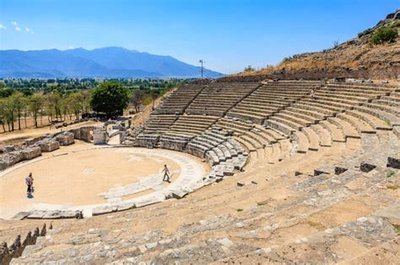
Paul had established the church at Philippi some ten years before on his Second Missionary Journey after a vision (Acts 16.9-15) and had a close relationship with the Christians there, notably Lydia and her household. Almost all Paul's letters start with an official reminder of who he is, ie 'an apostle of Jesus Christ', but with Philippians there is no need, this is a friend writing to his friends. His letter mentions the word 'joy' some 16 times!
Paul says that he and Timothy are servants of Jesus Christ, but the Greek word used is dulos not a servant, but rather a slave. There is a huge difference. A servant can come and go and works now and again, but a slave is the possession of his master. In the Roman world a slave was a thing, an object, not even considered a human being. Paul is indicating that he is the possession of Jesus Christ, who bought him at a price, ie his death (1 Corinthians 6.19-21). He owes his Lord absolute obedience for the act of love that Christ endured for him.
How does this thought affect our relationship to Jesus?
Prayer
Lord Jesu Christ,
all too often we can forget
the price you paid for us to become
the children of our Heavenly Father.
May our allegiance be one of joyfulness
at all that You have done to rescue us from sin.
May our morning hymns ascend to You,
and our evening prayers reflect
our total commitment to You,
as well as our grateful thanks.
Amen.
Here is a really good in-depth look at 'slave' verse 'servant':
Or read this: