Thoughts for the Day
Saturday, 10th October 2026: Acts - Day 52
Rome Paul Church Peter Acts 28 Mission
Reading : Verses from Acts, Chapter 28
Paul and Jewish Leaders in Rome
Three days later he called together the local leaders of the Jews. When they had assembled, he said to them, ‘Brothers, though I had done nothing against our people or the customs of our ancestors, yet I was arrested in Jerusalem and handed over to the Romans. When they had examined me, the Romans wanted to release me, because there was no reason for the death penalty in my case. But when the Jews objected, I was compelled to appeal to the emperor—even though I had no charge to bring against my nation.... ’ They replied, ‘We have received no letters from Judea about you, and none of the brothers coming here has reported or spoken anything evil about you. But we would like to hear from you what you think, for with regard to this sect we know that everywhere it is spoken against.’
Paul Preaches in Rome
After they had fixed a day to meet him, they came to him at his lodgings in great numbers. From morning until evening he explained the matter to them, testifying to the kingdom of God and trying to convince them about Jesus both from the law of Moses and from the prophets. Some were convinced by what he had said, while others refused to believe. So they disagreed with each other; and as they were leaving, Paul made one further statement: ‘The Holy Spirit was right in saying to your ancestors through the prophet Isaiah,
“Go to this people and say,
You will indeed listen, but never understand,
and you will indeed look, but never perceive.
For this people’s heart has grown dull,
and their ears are hard of hearing ....”
Let it be known to you then that this salvation of God has been sent to the Gentiles; they will listen.’
He lived there for two whole years at his own expense and welcomed all who came to him, proclaiming the kingdom of God and teaching about the Lord Jesus Christ with all boldness and without hindrance.
(Lectionary, New Revised Standard Version)
Thoughts
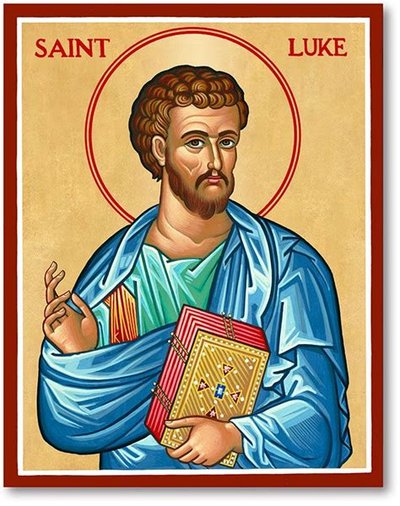
And so the physician Luke comes to the end of his narrative about the new Church, about Christianity. We have looked at the Book of Acts for 52 days now from the Ascension of Jesus and Pentecost with its arrival of the Holy Spirit, to its end where Paul is finally in Rome awaiting justice from the Emperor. Each event, from the stoning of Stephen to Philip's conversion of the Ethiopian Eunuch has accelerated the mission, but perhaps the catalyst for real change began with two calls, one to Peter and the other to Paul. Each were bidden to take their message that Jesus was the Messiah to the Gentiles (see Chapters 9-10).
At this point the spread of the good news begins to accelerate around the countries that make up the Roman Empire particularly through the work of St Paul. His has been a journey of great magnitude over a number of years. Paul constantly receives death threats and mob violence at almost every town he visits, but wherever he goes he stays true to his roots as a Pharisee - he starts with the Jewish community - before accepting his calling to the Gentiles. Some receive his message but many are hostile. Occasionally he spends a few weeks in a town, teaching and preaching, and at other times he and his companions spend much longer. But slowly Christianity spreads and grows.
Luke's account doesn't give us what happens to Paul at the end, but it's likely he was executed. However, the book ends with a shout of triumph, for we hear that Paul, though a prisoner in chains proclaimed 'the kingdom of God', and taught 'about the Lord Jesus Christ with all boldness and without hindrance'.
Prayer
Collect for Saint Peter and Saint Paul
Almighty God,
whose blessed Apostles Peter and Paul
glorified you in their death as in their life:
grant that your Church,
inspired by their teaching and example,
and made one by your Spirit,
may ever stand firm upon the one foundation,
Jesus Christ your Son our Lord,
who is alive and reigns with you,
in the unity of the Holy Spirit,
one God, now and for ever.
Amen.
You might like to read this:
- How did the Apostles spread the message of Jesus? (Christian.net)
Or play this hymn:
- Come let us join our cheerful songs (Chet Valley ymns and Songs)
Or this uplifting Gospel song:
- Send the light (Baptist Church, Orlando)