Thoughts for the Day
Wednesday, 7th October 2026: Acts - Day 49
Acts 27 Luke Paul Storms of life Storm
Reading : Verses from Acts, Chapter 27
Paul sails for Rome
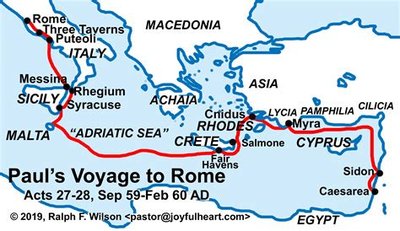
When it was decided that we were to sail for Italy, they transferred Paul and some other prisoners to a centurion of the Augustan Cohort, named Julius. Embarking on a ship of Adramyttium that was about to set sail to the ports along the coast of Asia, we put to sea, accompanied by Aristarchus, a Macedonian from Thessalonica. The next day we put in at Sidon; and Julius treated Paul kindly, and allowed him to go to his friends to be cared for. Putting out to sea from there, we sailed under the lee of Cyprus, because the winds were against us. After we had sailed across the sea that is off Cilicia and Pamphylia, we came to Myra in Lycia. There the centurion found an Alexandrian ship bound for Italy and put us on board. We sailed slowly for a number of days and arrived with difficulty off Cnidus, and as the wind was against us, we sailed under the lee of Crete off Salmone. Sailing past it with difficulty, we came to a place called Fair Havens, near the city of Lasea.
Since much time had been lost and sailing was now dangerous, because even the Fast had already gone by, Paul advised them, saying, ‘Sirs, I can see that the voyage will be with danger and much heavy loss, not only of the cargo and the ship, but also of our lives.’ But the centurion paid more attention to the pilot and to the owner of the ship than to what Paul said. Since the harbour was not suitable for spending the winter, the majority was in favour of putting to sea from there, on the chance that somehow they could reach Phoenix, where they could spend the winter. It was a harbour of Crete, facing south-west and north-west.
The storm at sea
When a moderate south wind began to blow, they thought they could achieve their purpose; so they weighed anchor and began to sail past Crete, close to the shore. But soon a violent wind, called the northeaster, rushed down from Crete. Since the ship was caught and could not be turned with its head to the wind, we gave way to it and were driven. By running under the lee of a small island called Cauda we were scarcely able to get the ship’s boat under control. After hoisting it up they took measures to undergird the ship; then, fearing that they would run on the Syrtis, they lowered the sea-anchor and so were driven. We were being pounded by the storm so violently that on the next day they began to throw the cargo overboard, and on the third day with their own hands they threw the ship’s tackle overboard. When neither sun nor stars appeared for many days, and no small tempest raged, all hope of our being saved was at last abandoned.
Since they had been without food for a long time, Paul then stood up among them and said, ‘Men, you should have listened to me and not have set sail from Crete and thereby avoided this damage and loss. I urge you now to keep up your courage, for there will be no loss of life among you, but only of the ship. For last night there stood by me an angel of the God to whom I belong and whom I worship, and he said, “Do not be afraid, Paul; you must stand before the emperor; and indeed, God has granted safety to all those who are sailing with you.” So keep up your courage, men, for I have faith in God that it will be exactly as I have been told. But we will have to run aground on some island.’
(Lectionary, New Revised Standard Version)
Thoughts
(Today's comment has been kindly written by Tim, a Lay Reader and professional actor).
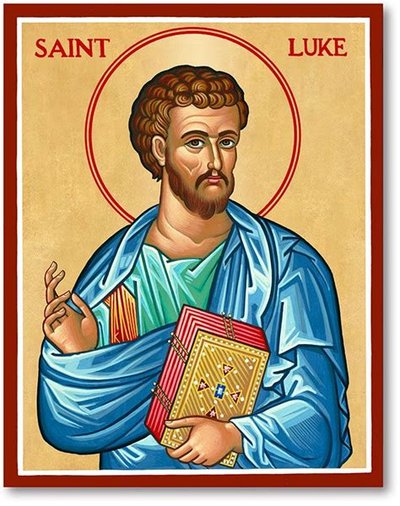
At last Paul's longing to go to Rome is being fulfilled. A mixed bag of prisoners are likely being sent, most accused of regular crimes. Luke writes “We put to sea”. He has rejoined Paul and may have been with him in Caesarea. We don't know who Aristarchus was but he would stay with Paul when he was in Rome (Colossians 4.10). Centurion Julius seems a decent man and clearly trusts Paul when he lets him go to his friends in Tyre.
Destination Rome was due west but the frail ships of those day tried to stay close to land so they take a long route round the coast of Turkey (see map below). Luke's description of the voyage is as detailed as a documentary and will become as exciting as any novel about pirates or naval heroes. Throwing cargo overboard was the first thing the sailors did in Jonah's ship (Jonah 1.4-5).
“The Fast” mentioned was the Day of Atonement which is observed in late September or early October so they were travelling late in the year when storms were likely. Paul's warning at Fair Havens is his view as a seasoned traveller. Julius trusts the professionals instead, but the pilot won't get paid if he doesn't guide the ship out of port, and the shipowner probably wants his cargo delivered and sold as soon as possible. The wind from Crete, often known as the Levanter, drives them southwest towards Africa. They must have been towing the lifeboat and hauled it in before the rope broke.
As we can see Paul can't resist an “I told you so” before his revelation about the angel. The message is striking; they will be safe as Paul “must stand before the emperor”. Because God has a plan for one man it will affect everyone associated with him. From now on Paul is completely confident – not from his own seafaring knowledge but from his trust in God. He will have known Proverbs 3.5 - Trust in the Lord with all your heart and lean not on your own understanding.
Prayer
Lord God,
a we journey through life
with all sorts of people, saints and criminals,
we may be surrounded by storms and disasters:
forces driving us the wrong way,
and we may feel lost with no fair haven in sight.
Strengthen our faith that you have a destination for us,
and give us grace to trust in you with all our heart.
Amen.
You might like to look at this:
- Paul's journey to Rome.
Or play this:
- Through all the changing scenes of life (Chet Valley Hymns and Songs)