Thoughts for the Day
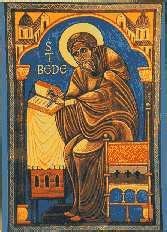
Monday, 25th May 2026: The Venerable Bede (c670 - 735 CE)
Venerable Bede Ecclesiasticus 39 Teacher Translator
Reading : Verses from Ecclesiasticus, Chapter 39
How different the one who devotes himself
to the study of the law of the Most High!
He seeks out the wisdom of all the ancients,
and is concerned with prophecies;
he preserves the sayings of the famous
and penetrates the subtleties of parables;
he seeks out the hidden meanings of proverbs
and is at home with the obscurities of parables.
He serves among the great
and appears before rulers;
he travels in foreign lands
and learns what is good and evil in the human lot.
He sets his heart on rising early
to seek the Lord who made him,
and to petition the Most High;
he opens his mouth in prayer
and asks pardon for his sins.
If the great Lord is willing,
he will be filled with the spirit of understanding;
he will pour forth words of wisdom of his own
and give thanks to the Lord in prayer.
The Lord will direct his counsel and knowledge,
as he meditates on his mysteries.
He will show the wisdom of what he has learned,
and will glory in the law of the Lord’s covenant.
Many will praise his understanding;
it will never be blotted out.
His memory will not disappear,
and his name will live through all generations.
Nations will speak of his wisdom,
and the congregation will proclaim his praise.
(Lectionary, New Revised Standard Version)
Thoughts
Today's lectionary reading comes from Ecclesiasticus, Hebrew wisdom literature, and was apparently written by the, grandson of Sirach, sometime between 190 and 170 BCE. Set as a reading for today, when we remember the Venerable Bede, it has much to teach us about how we should live our life as a Christian, and about how the 8th century monk lived his life.
Bede was born in Northumbria around the year 670 CE. When he was seven years old his family gave him to the monastery of St Peter and St Paul in Wearmouth. Here he would be educated and accepted as a monk in due course. He eventually moved from there to Jarrow, where he lived for the rest of his life. Although it seems he never travelled further than York, his monastery - first under Abbot Benet Biscop and then Abbot Ceolfrith - was a centre of learning, and Bede studied extensively. He and Abbot Ceolfrith survived the plague in 686 CE that killed most of the population in the area.
His theological writings were extensive and included a number of Biblical commentaries and other works. He is considered by many historians to be the most important scholar of antiquity for the period between the death of Pope Gregory in 604 CE, and the coronation of Charlemagne in 800 CE. Bede was moreover a skilled linguist and translator, and his work made the Greek and Latin writings of the early Church Fathers much more accessible to his fellow Anglo-Saxons.
He was renowned for his monastic fidelity and his love of teaching, and was fondly remembered by his pupils, including his biographer. He died peacefully in 735 CE. Pope Leo XIII declared him 'A Doctor of the Church' in 1899, and he is buried in Durham cathedral.
Prayer
Collect
Almighty God,
who has enriched your church
with the learning and holiness of your servant Bede:
Grant us to find in Scripture and disciplined prayer
the image of your Son our Saviour Jesus Christ,
and to fashion our lives according to his likeness,
to the glory of your great Name
and to the benefit of your holy church.
Amen.
You might like to read this:
- What is Ecclesiasticus? (Bible Hub)