Thoughts for the Day
Monday, 22nd December 2025: The Magnificat
Mary Canticle The Magnificat Praise Luke 1
Reading : Verses from Luke, Chapter 1
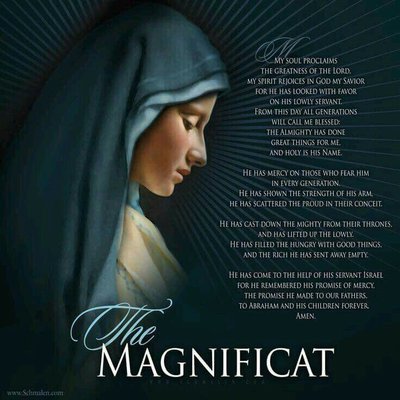
Mary’s Song of Praise
And Mary said,
‘My soul magnifies the Lord,
and my spirit rejoices in God my Saviour,
for he has looked with favour on the lowliness of his servant.
Surely, from now on all generations will call me blessed;
for the Mighty One has done great things for me,
and holy is his name.
His mercy is for those who fear him
from generation to generation.
He has shown strength with his arm;
he has scattered the proud in the thoughts of their hearts.
He has brought down the powerful from their thrones,
and lifted up the lowly;
he has filled the hungry with good things,
and sent the rich away empty.
He has helped his servant Israel,
in remembrance of his mercy,
according to the promise he made to our ancestors,
to Abraham and to his descendants for ever.’
(Lectionary, New Revised Standard Version)
Thoughts
The Magnificat is a Canticle*, referred to as the Magnificat because in Latin, the word means "magnify," "glorify," or "exalt". It's a glorious hymn of praise based on a passage found in the first chapter of Luke's Gospel when Mary goes to her cousin Elizabeth's house after being told by the angel Gabriel that she is to bear God's Son. It is a profound declaration of Mary's faith and her response to God's message. It says much for Mary that she sees this as a blessing, rather than a burden too great to bear. But filled with the Holy Spirit, Mary exalts God for His greatness, for His mercy, and for His faithfulness. She begins by praising the Lord and rejoicing in God who is her Saviour, and continues by praising His actions of justice and mercy. The Magnificat celebrates God's past faithfulness to the people of Israel but also looks at His ongoing mercy to future generations.
I have sung the Magnificat for over 70 years in tin chapels, majestic cathedrals, and ancient stone parish churches, sometimes to simple musical settings with a few people and sometimes with elaborate settings with hundreds of people. It is a traditional canticle for Evensong, and it never fails to move my heart with its words of hope and praise.
Mary's words echo a number of passages from the Hebrew scriptures, notably from Hannah's prayer in 1 Samuel 2.1-10 when she exalts God after giving birth to her son and offering him back to God for his lifetime. In her prayer she too praises God for his actions of justice and mercy. You can see a comparison of Mary's hymn of praise and Hannah's prayer below..
The Magnificat is an example of how we can praise God in our own life, acknowledging His presence and work in our life. We too can magnify God by recognizing and celebrating His blessings, mercy, and faithfulness. This involves a conscious effort to shift our focus from our challenges to His power and goodness.
* I looked at the meaning of Canticles recently, see 2nd para of Benedicite - 1
Prayer
Heavenly Father,
as we come closer to Christmas
help us to appreciate what is good and healthy
in the way we live our life,
and the importance of human relationships
over material concerns.
This Christmas may we find time for one another,
and for You,
to celebrate all that this season means to us.
Amen.
You might like to look at this:
Or listen to this:
- The Magnificat - modern version by Bernadette Farrell (Chet Valley Churches)