Thoughts for the Day
Sunday, 29th March 2026: Palm Sunday 2026
Humility Palm Sunday Nelson Mandela Matthew 21 Jesus the King
Reading : Verses from Matthew, Chapter 21
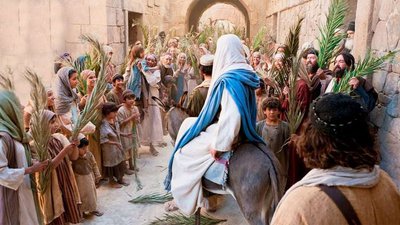
Jesus’ Triumphal Entry into Jerusalem
When they had come near Jerusalem and had reached Bethphage, at the Mount of Olives, Jesus sent two disciples, saying to them, ‘Go into the village ahead of you, and immediately you will find a donkey tied, and a colt with her; untie them and bring them to me. If anyone says anything to you, just say this, “The Lord needs them.” And he will send them immediately.’ This took place to fulfil what had been spoken through the prophet, saying,
‘Tell the daughter of Zion,
Look, your king is coming to you,
humble, and mounted on a donkey,
and on a colt, the foal of a donkey.’
The disciples went and did as Jesus had directed them; they brought the donkey and the colt, and put their cloaks on them, and he sat on them. A very large crowd spread their cloaks on the road, and others cut branches from the trees and spread them on the road. The crowds that went ahead of him and that followed were shouting,
‘Hosanna to the Son of David!
Blessed is the one who comes in the name of the Lord!
Hosanna in the highest heaven!’
When he entered Jerusalem, the whole city was in turmoil, asking, ‘Who is this?’ The crowds were saying, ‘This is the prophet Jesus from Nazareth in Galilee.'
(Lectionary, New Revised Standard Version)
Thoughts
A ruler would normally enter a city in some state. Pontius Pilate, for example at this time entered Jerusalem for the Passover accompanied by his soldiers. When a king came into a city after a victorious battle he would ride on a white horse. Sometimes a king would enter on a donkey, to symbolise that he came in peace. Jesus came into the city on a donkey, to demonstrate that God’s kingdom was one of love and peace.
We all know stories of men or women throughout history who were humble. For me such a person was Nelson Mandela. He came to London just after South Africa became a united country and he and President F.W. de Klerk were both awarded the Nobel Prize for Peace. A service was held in Westminster Abbey, where my younger son was a chorister. At the end of the service Mr Mandela went to shake hands with one of the boys to thank them for their singing, but suddenly pulled back his hand and said “Do you a white boy mind shaking my hand.” Needless to say all the boys were astounded that this great man whom they had heard so much about should imagine that they wouldn’t want to shake his hand, and of what a privilege it was to meet him!
Two thousand years ago those watching the entrance of Jesus into Jerusalem would have known the significance of what they were seeing, for Zechariah had prophesied that the Messiah would come ‘humble and riding on a donkey, on a colt, the foal of a donkey.’ (Zech 9.9) The difference between this action and that of Nelson Mandela is that Jesus was the Messiah, the Son of God, fully human and fully God, entering God’s Holy City of Jerusalem, knowing that he was innocent but was coming to die for the sins of humanity.
Prayer
Heavenly Father,
we give You thanks that Your Son, our Saviour, Jesus Christ,
in all humility came to His own people
that they might be redeemed from sin
and brought back into Your loving care.
As we celebrate Palm Sunday today we remember
the great sacrifice that He was about to make
for all who believe in Him.
Amen.
You might like to listen to these:
- All Glory, Laud and Honour (Sunday 7pm Choir)
- Ride on, ride on in Majesty (North Stoneham and Bassett Parish)