Thoughts for the Day
Monday, 23rd February 2026: Lent Day 5/2026
Leviticus 19 Set apart Love one another Holy
Reading : Verses from Leviticus. Chapter 19
Ritual and Moral Holiness
The Lord spoke to Moses, saying:
'Speak to all the congregation of the people of Israel and say to them: You shall be holy, for I the Lord your God am holy....
You shall not steal; you shall not deal falsely; and you shall not lie to one another. And you shall not swear falsely by my name, profaning the name of your God: I am the Lord.
You shall not defraud your neighbour; you shall not steal; and you shall not keep for yourself the wages of a labourer until morning. You shall not revile the deaf or put a stumbling-block before the blind; you shall fear your God: I am the Lord.
You shall not render an unjust judgement; you shall not be partial to the poor or defer to the great: with justice you shall judge your neighbour. You shall not go around as a slanderer among your people, and you shall not profit by the blood of your neighbour: I am the Lord.
You shall not hate in your heart anyone of your kin; you shall not reprove your neighbour, or you will incur guilt yourself. You shall not take vengeance or bear a grudge against any of your people, but you shall love your neighbour as yourself: I am the Lord.'
(Lectionary, New Revised Standard Version)
Thoughts
The book of Leviticus is all about being 'Holy', indeed the word occurs 94 times in the book. God is Holy and His people should be holy. But what does the word 'holy' really mean? In the Hebrew scriptures (our Old Testament) the word 'holy' means to be 'set apart', or to be special. As God exceeds His people in showing greater love, goodness, mercy and justice than human beings, so God calls His people to show these characteristics in their own lives. There is also a sense of being set apart as a nation admittedly, but only so that the people are not contaminated by local tribes and their practices! Throughout the book of Leviticus we see the practical working out of the original Ten Commandments, showing how the people should apply these to their daily lives.
Jesus himself reduced the Ten Commandments down to Two Commandments to look at what being holy meant, teaching the people to love God, and to love their neighbour as themself (Matthew 30.22-37). For he knew that when they loved other people, not just their literal neighbours, but the stranger and outcast as well, then they would show mercy, justice, and goodness to them.
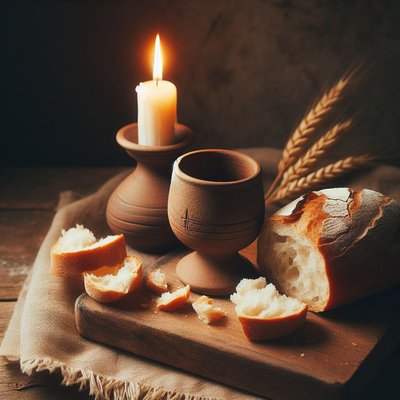
Today, Day 5 of Lent, we are accustomed to things being ordinary while also being special. We eat bread and drink wine at home or in a restaurant, yet we also set these two basic items apart as special in church to celebrate our Lord's last supper. From this we draw strength as ordinary people to go out into the world as God's holy people. For as God is pure, as God is good, so should we His people try to follow our Lord's example.
Prayer
Lord God,
You call us to be holy
as you are holy;
to treat others as we
would wish to be treated ourselves;
to love others
as we love ourselves;
and to approach You
with confidence each day.
This Lent may we answer this call.
Amen.
You might like to look at this excellent cartoon style video on God and Holiness in the Bible. The speed might need slowing down a little.
You might also like to look at this site: