Thoughts for the Day
Friday, 17th April 2026: Eastertide - John, 5
Last Supper John 6 Feeding of the 5000 Sign Eastertide Communion Service
Reading : Verses from John, Chapter 6
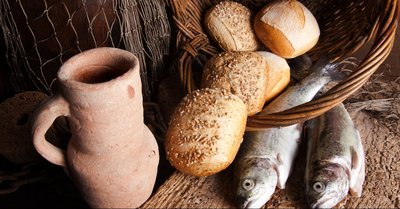
After this Jesus went to the other side of the Sea of Galilee, also called the Sea of Tiberias. A large crowd kept following him, because they saw the signs that he was doing for the sick. Jesus went up the mountain and sat down there with his disciples. Now the Passover, the festival of the Jews, was near. When he looked up and saw a large crowd coming towards him, Jesus said to Philip, ‘Where are we to buy bread for these people to eat?’ He said this to test him, for he himself knew what he was going to do. Philip answered him, ‘Six months’ wages would not buy enough bread for each of them to get a little.’ One of his disciples, Andrew, Simon Peter’s brother, said to him, ‘There is a boy here who has five barley loaves and two fish. But what are they among so many people?’ Jesus said, ‘Make the people sit down.’ Now there was a great deal of grass in the place; so they sat down, about five thousand in all. Then Jesus took the loaves, and when he had given thanks, he distributed them to those who were seated; so also the fish, as much as they wanted. When they were satisfied, he told his disciples, ‘Gather up the fragments left over, so that nothing may be lost.’ So they gathered them up, and from the fragments of the five barley loaves, left by those who had eaten, they filled twelve baskets. When the people saw the sign that he had done, they began to say, ‘This is indeed the prophet who is to come into the world.’
(Lectionary, New Revised Standard Version)
Thoughts
John in his Gospel calls Jesus' miracles 'signs' and these signs point to something else, they are not just an amazing happening, they teach those past and present something about God. We all know the story of the Feeding of the 5,000 - Jesus seeks to get away with his disciples perhaps to carry out teaching, and also to allow him time to be with God, but the people follow them to a large stretch of land some miles east of Capernaum. We cannot know exactly what happened at the end of this day but there are things and people to note. What happened was a miracle, either the barley loaves and fish were turned into food that fed all the people; or the boy's offering caused everyone to be generous with what they already possessed for It seems unlikely that the people would have gone for a long walk in the countryside without taking food with them. Either outcome would have seemed like a miracle, though I personally am happy for it simply to be one of our Lord's miracles.
Now lets look at the people who are involved, notice Philip and Andrew and the contrast between them. Philip says the situation is hopeless, nothing can be done, but Andrew seems to have an idea that maybe Jesus can help, so he goes and finds a lad with two little fish (sardine size) and five barley loaves (the poorest kind of loaves usually given to animals) and though the situation is still the same he presents them to Jesus with hope for an outcome. Then there is the boy with nothing much to give, but Jesus will use this meagre offering to perform a miracle.
But there is a much bigger picture: over and above Jesus' compassion for the people and his ability to provide for them. John in his Gospel sees this as evidence that God is not limited by our feeble offerings or by events we see as being impossible. God knows our needs before we turn to Him, and we need to trust Him for His help even when we cannot see a way forward. This story should encourage us to trust in God's ability to provide abundantly, in His own way and in His perfect timing.
Prayer
Lord Jesus Christ,
as Your compassion was extended to that hungry crowd
on the hillside in Galilee,
and as You responded to Andrew's tentative action
in finding a lad with fish and bread to offer,
we pray that You will accept our prayers this day,
all too often half-hearted,
and frequently minimal.
We do not deserve Your generosity,
but we ask that You give us the help we need,
out of Your goodness,
Amen.
You might like to listen to this hymn noting especially the words that find links connecting the Feeding of the 5,000 to the Last Supper, and the Communion Service:
- Come to the feast (Sunday 7 pm Choir)